Summary
- The Virgin of Guadalupe, also known as Our Lady of Guadalupe, is Mexico’s most important Catholic figure and a powerful symbol of devotion, identity, and patriotism.
- She first appeared to Juan Diego, a native peasant, on December 9, 1531, on the hill of Tepeyac, near Mexico City. She asked him to build a church in her honor on that spot.
- The cloak, or tilma, is made of cactus fibers and has survived for almost five centuries. It is displayed in the Basilica of Guadalupe, the most visited Catholic shrine in the world.
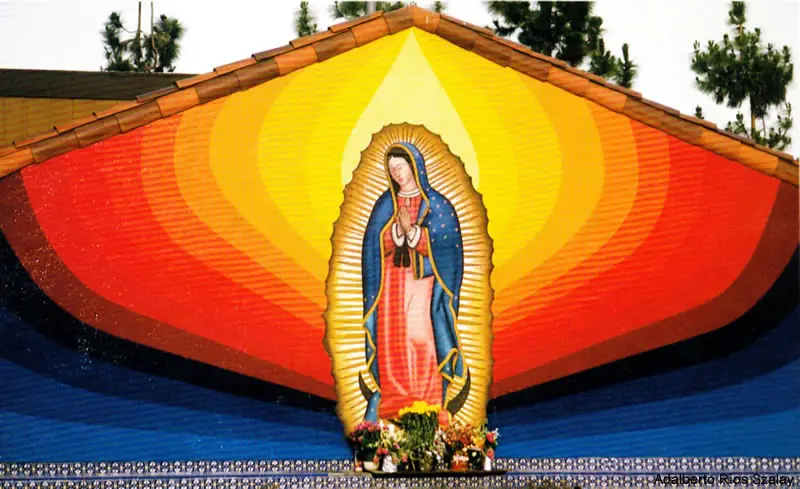
- The image of the Virgin has many symbolic elements that reflect the fusion of the indigenous and Spanish cultures. For example, she wears a blue-green mantle with stars, which represents the heavens and the Aztec god Quetzalcoatl. She also wears a black ribbon around her waist, which signifies pregnancy and fertility.
- The Virgin of Guadalupe is considered the mother of all Mexicans and the empress of the Americas. She is a symbol of national identity, unity, and faith for millions of Mexicans, Catholic or not.
- The Virgin of Guadalupe has been involved in many historical events in Mexico, such as the independence movement, the revolution, and the Cristero War. She has also inspired many artists, such as Diego Rivera, Frida Kahlo, and Octavio Paz.
- The Virgin of Guadalupe has been recognized by the Catholic Church as the patroness of Mexico and the Americas. She has been granted several titles, such as Our Lady of the New Evangelization, Queen of Mexico, and Star of the New Evangelization.
- The Virgin of Guadalupe has a feast day on December 12, which is a national holiday in Mexico. Millions of pilgrims visit the Basilica of Guadalupe every year, especially on this date, to pay homage to the Virgin and ask for her intercession.


By Debora Arriaga Weiss
I owe it all to my manager and to the Virgin of Guadalupe.
Raúl “Ratón” Macías, boxer.
Infinite are the favors granted by the Virgin of Guadalupe. As Mexicans, Catholic or not, millions of us take refuge under her comforting starry mantle. She is our Guadalupe. mother of all Mexicans, the Morenita del Tepeyac.
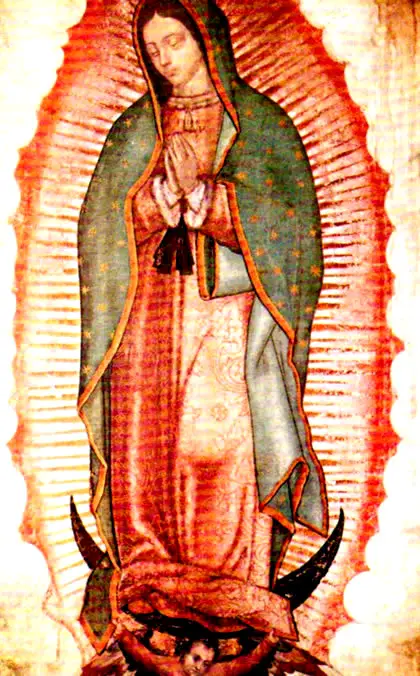
Virgin of Guadalupe, the mysterious ayate, an image that is venerated by the faithful. As proof of her apparition on December 12th, 1531, the virgin impressed her image on a cloth woven from maguey fiber that cloaked the mystic, clairvoyant Aztec Indian, Juan Diego.
Virgin-Mother, Santa Maria de Guadalupe is the banner that weaves maguey threads with those of silk into a tapestry of cultures and beliefs: of Tonantzin, our Madrecita (little Mother), Mother Earth, mother of gods and men, and Holy Mary Mother of God. Guadalupe-Tonantzin, a symbol of national identity, an emblem of unity, a combination of indigenous and Iberic roots, the initial fusion of pre-Hispanic Mexico with the West, and through it, with the East.
Beyond mere religious, social or psychological interpretations, one is Guadalupan because one is Mexican –goes the popular saying-, it symbolizes the national devotion which attaches us to this mother figure and unites us with our Guadalupan brothers and sisters around the world. One assumes it like an identity.. a vocation taken as an act of faith not to be argued or questioned. It is a mystery to be accepted, lived and felt.
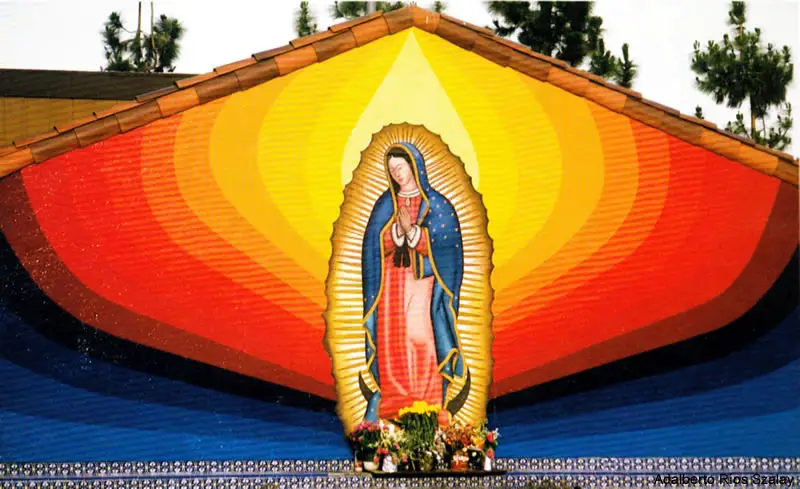
Approximately 90 million Mexicans are devotees of our Patroncita, our Little Patroness, Queen of Mexico, Empress of the Americas and the Phillippines. She protects us with her spirit, which lives inside us all. She is our inner voice that says: What do you fear? Am I not here, your Mother? She is also there in her Basilica in the Tepeyac foothills north of Mexico City.
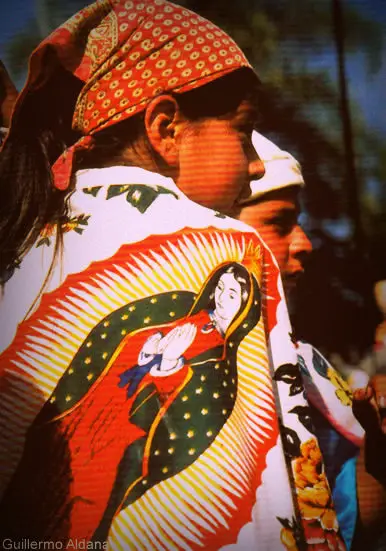
There are 90 million Virgin of Guadalupe devouts
No matter health or weather conditions, millions of faithful come from all parts of the country to thank their Virgencita, little Virgin of Guadalupe. Their influx makes Mexico City one of the main religious centers on Earth, on a par with Mecca, Rome, or Jerusalem. Every year more than 15 million pilgrims from around the world converge on the Villa de Guadalupe, making it the second most important center of Catholic worship after Saint Peter’s Basilica in Rome.
That is why in Mexico all roads lead from Tepeyac and all roads lead to Tepeyac.
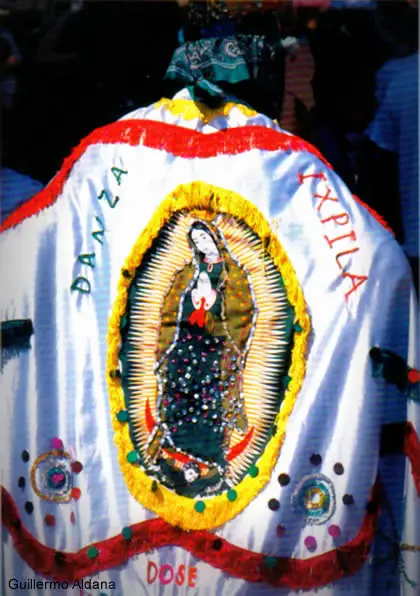
Protective cloak, for the pilgrims, wearing the image of the Virgin of Guadalupe on their back is a sign that the Mother of God is always watching over them and lovingly heeds requests for her intervention.
DECEMBER 12, A DAY OF WORSHIP
Traffic in many parts of Mexico City is momentarily stopped. People on foot, cars, cyclists, buses, and trucks filled with men, women, and children parade through the city streets, carrying flags, banners, garlands, and flowers on their way north. Everyone knows that they are pilgrims going to the Villa to pay homage to the Virgen Morena, to the Brown-Skinned Lady. During the course of a year, more than two thousand pilgrimages are carried out. All roads lead to Tepeyac.
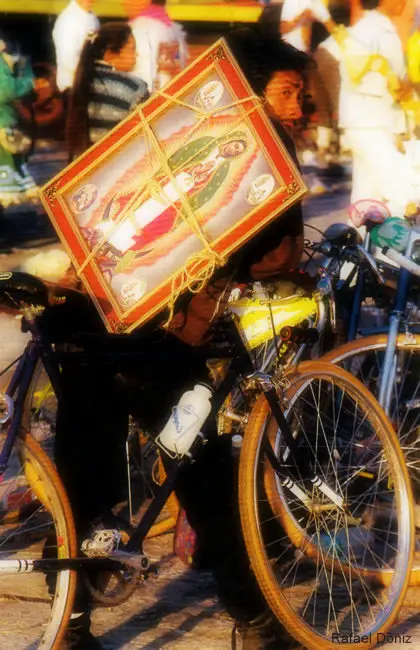
Between December 11 and 12, several million pilgrims from all over the country, despite the weather, health or transport, converge on the Sanctuary of the Virgin of Guadalupe on Tepeyac Hill, north of Mexico City.
On December 12, however, traffic comes to a complete standstill. Schools, businesses, banks and private companies stop their activities on that day. Even unionized college employees and some public offices have the day or afternoon off. Everyone urgently needs to be at the Basilica, with Her, with the Guadalupana, on her day.
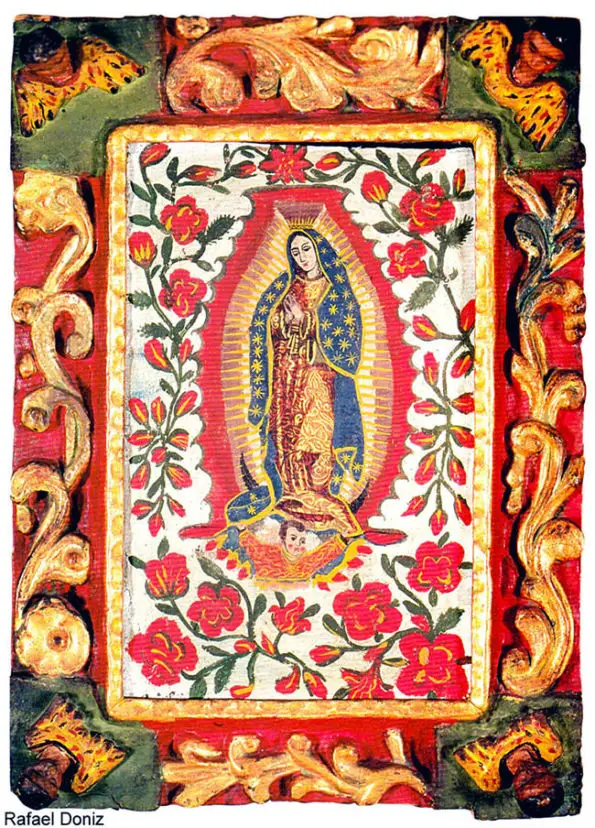
La Virgen de Guadalupe, Santa María
The event that is being remembered occurred in the year 1531: the last appearance of Guadalupe to the now beatified Juan Diego. In a secular State, this religious commemoration has turned into a national holiday, and now also a day of celebration throughout the Americas, as declared by Pope John Paul II on his last visit to Mexico.


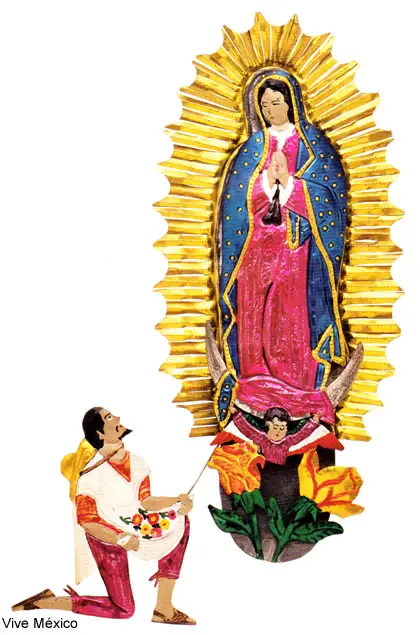
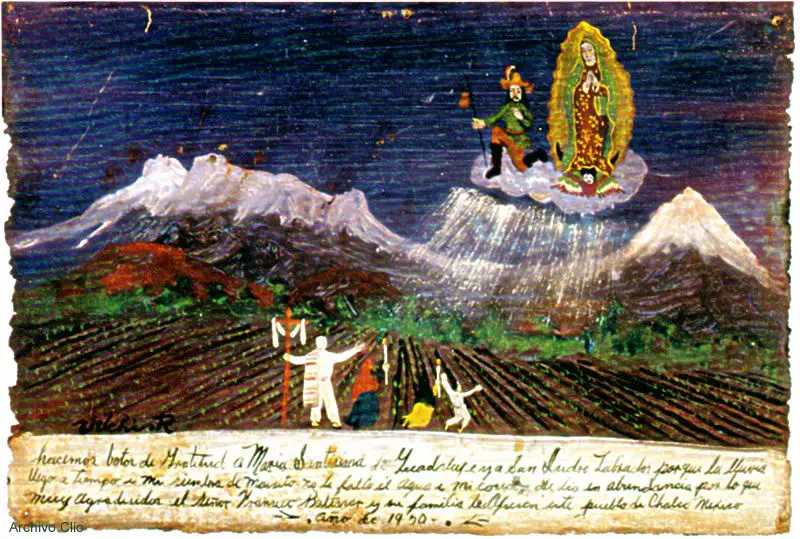
Popular Art
Although our Constitution does not recognize titles of nobility, every Mexican knows that December 12 is the day of our Queen. She and the thousands of women and men named Guadalupe are celebrated and honored on that date. In Mexico, all of us are fortunate enough to have a Lupe close by.
Festivities for December 12 start before that date. People come to her Basilica one day early and wait just to be there when the zero hour marks the beginning of her glorious day, so they can sing Las Mañanitas to Lupita, the Brown—skined Virgin. The Guadalupan event is repeated, honored, and celebrated. Millions of Viva! and resounding applause can be heard. The air is filled with laughter and shouting, choruses and songs, music and mariachis. “Wake up, my dearest, wake up, it’s morning already”, goes the traditional refrain sung to the accompanying thunder of exploding fireworks. The party in honor of Mexico’s patron saint has begun: an immense gathering of people united in praise of Our Lady of Mexico, the Lady of Tepeyac.
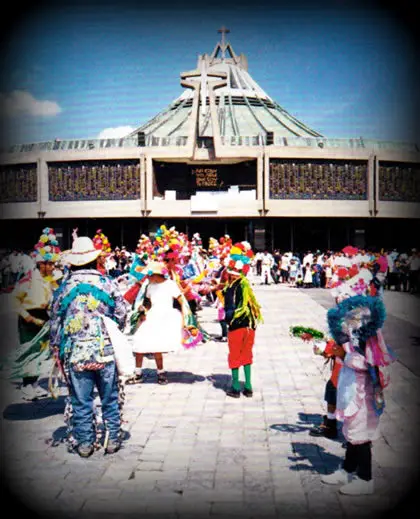
Dance troupes from every region of the country and every ethnic group turn the esplanade in front of the Basilica of Guadalupe into the largest and most festive stage in the country.
Streets around the hills of Tepeyac soon become filled with worshippers. The vast esplanade in front of the old and new sections of the Basilica – examples of architecture spanning 400 years – is teeming with the faithful, men and women of all ages and social condition. Worshippers -kneeling, standing, healthy and sick-, pilgrims of all trades and professions, join together in holy peace to adore the Virgin-Mother on her day.
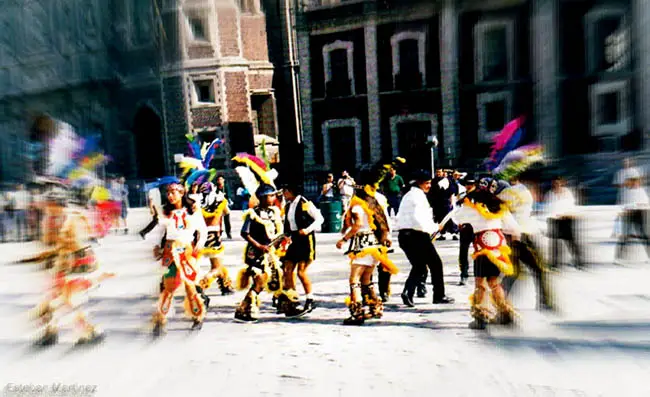
Dancing in front of the Basilica
Millions of flowers decorate this fiesta of faith, a display of belief in Guadalupe-Tonantzin, in her miracles, her intervention, and protection. The demonstrations of love and appreciation of favors received abound. There is prayer and supplication. More favors are asked, accompanied by fervent promises of greater adoration. The thousands of worshippers are proof of the undying gratitude bestowed upon the Virgin of Guadalupe for her infinite love.
There is music and song. Mariachis can be heard along with local bands, student ensembles, and rock groups. Open spaces serve to host a variety of indigenous dances, accompanied by conchero and neo-Aztec rituals. Sounds and rhythms merge in an explosion of music produced by pre-Hispanic instruments such as flutes, hornpipes, semillas de fraile, huehuetls, teponaxtles, conch and other shells, combined with European accordions, guitars, trumpets and others.
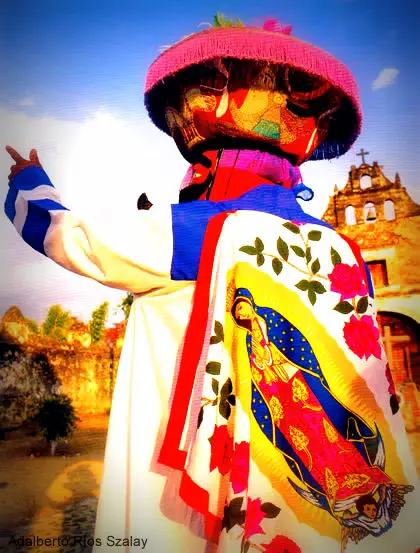
Colorful traditional garb, the protective cloak on his back
Many wear the traditional clothes of their region. and some children are dressed up in the same garb that the Indian Juan Diego reputedly wore. It is a multicolored hive, comprised of several million people united in peaceful celebration of our Madrecita. And so until nightfall, as it has been for centuries and will continue into the mists of time.
The Guadalupano is a devoted walker. Some pilgrims arrive barefoot, others wearing huaraches, sandals, running shoes, moccasins, high heels… any footwear. Feet, more feet, millions of feet multiplied by two. And that doesn’t include those who walk on their knees.
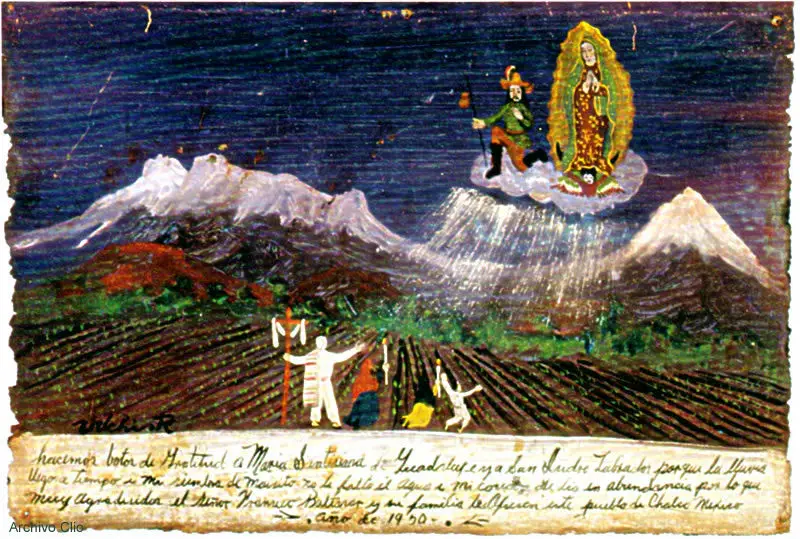
It doesn’t matter how they get here, how they walk, or where they come from. No matter that it’s cold or that the winter wind chills them. Spending the night outdoors is no burden. Faith in the Virgin makes up for all discomforts. Anything, just to be in the Tepeyac Sanctuary near Her, She who is always close to us, always there. On this day, everyone wants to be in the Virgin’s home.
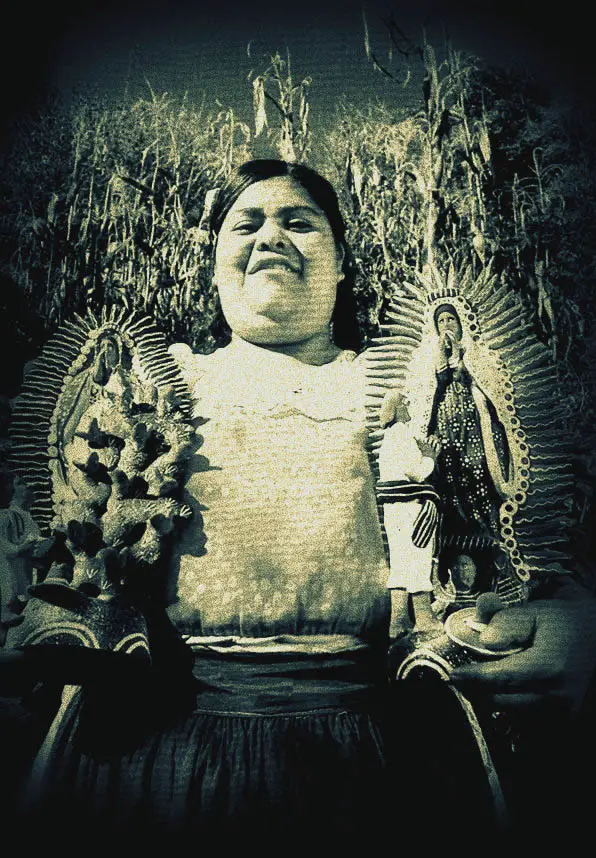
Different versions of the Virgin
The happiness and joy of many worshippers often becomes a cry that melts into an atmosphere charged with energy and hope. What transpires is more an act of faith than one of religion; more than an individual action, a collective supplication for a better Mexico and a kinder world. The Virgin lives in our hearts, and where the Virgin of Guadalupe lives…there is hope.
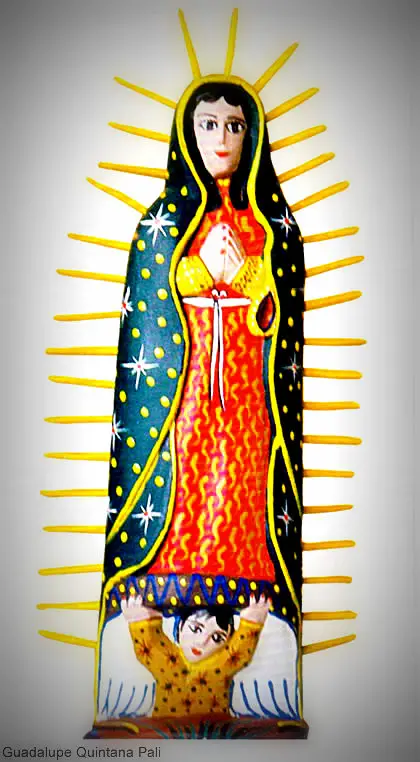
Virgin of Guadalupe woodcarving
All roads lead from Tepeyac: one leaves the sanctuary with the comforting knowledge that we are not alone. Because. undoubtedly, we are under the mantle of her protection, safe in her embrace. What more could we desire?
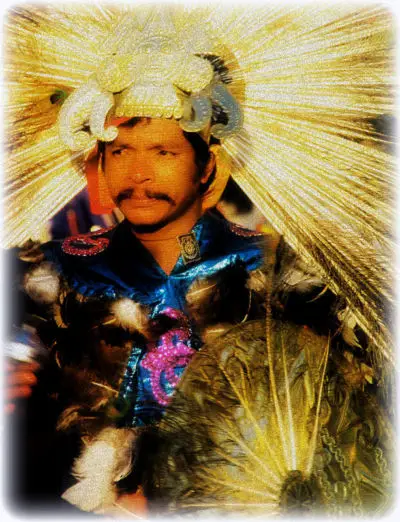
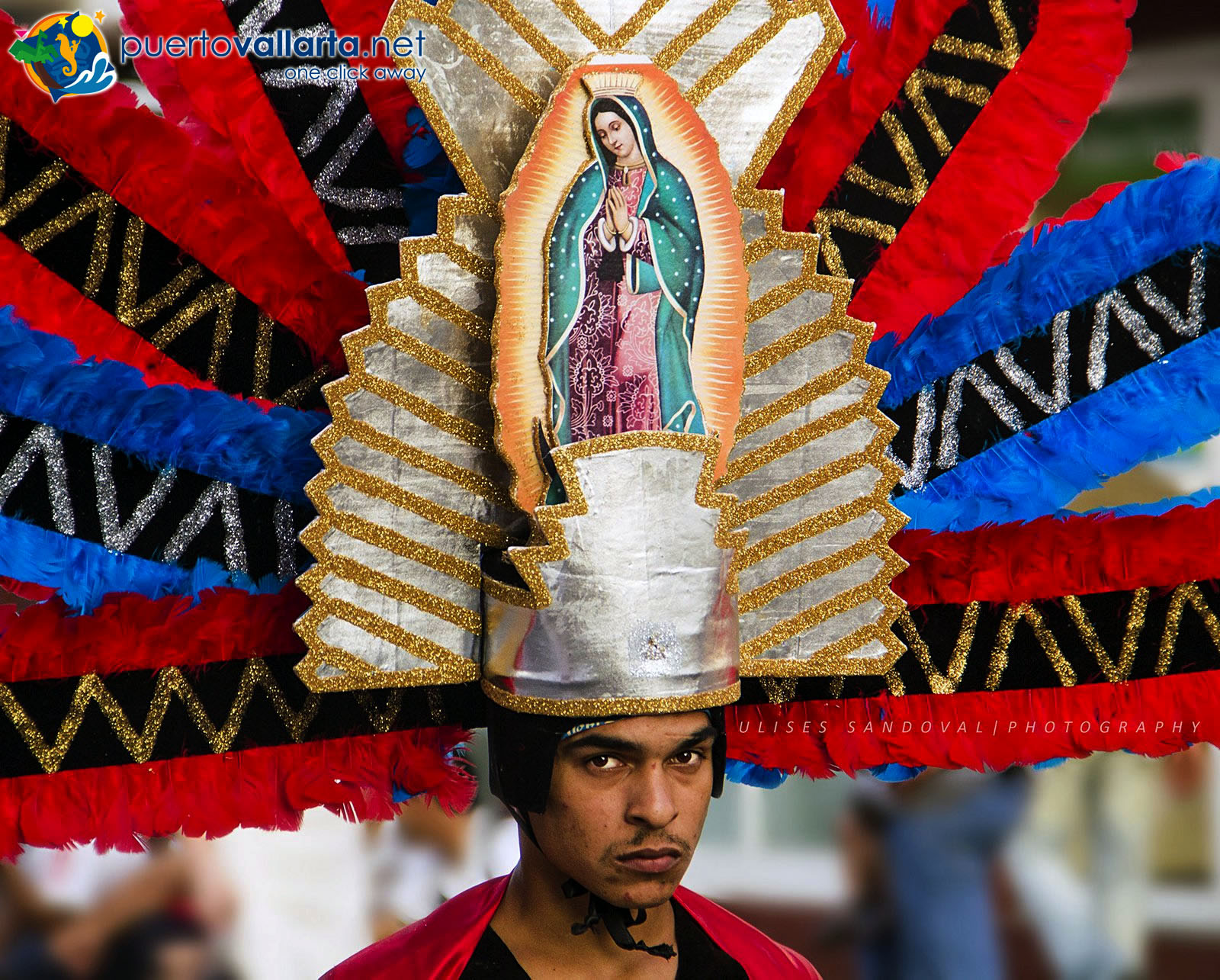
Modern Aztec “warrior of light”, another expression of the Guadalupana faith
No question about it, that’s how we Mexicans are, those of us who consider ourselves children of the Virgin of Tepeyac. Without a doubt, one is Guadalupano because there is no other way to be.
FAQ

Book tours & support us
- Best prices
- 100% Local Support
- 2 decades+ of experience in Puerto Vallarta
Puerto Vallarta news, tips & content
- New info every two weeks
- Free content, news, videos
- Unsubscribe at any time

Contact us via WhatsApp
- Talk with our reservations expert
- Real local and human support
- Book tours, hotels, transfers, and more.
Last updated on:
Share this article, choose your favorite option!